
The Nightsuit
let's get a little commotion for the pyjamas

I
Thick, brushed cotton in blue and white gingham that feels distinctly Paddington bear-esque; pink and white seersucker cotton so thin that in summer it feels like wearing ice cream; cream muslin trousers with a rip in an unfortunate place; a starch white Victorian nightgown with frilled sleeves that I keep putting off buying for the same reason I won’t buy Damson Madder pyjamas, which is that I have to spend my money on slightly more important things, like food and water; the time there was a fire drill at university in the early morning and I was wearing an old kameez with the muslin trousers (pre-rip), and I stood shivering outside in them and a girl said, ‘I like your outfit.’ She said ‘outfit’ because she didn’t realise I was wearing my pyjamas.
II
Pyjamas, as the Western world knows them, owe their origins to a time in the 18th and 19th centuries when the British — who, at that time, male or female, pretty much exclusively wore nightgowns to bed — were in India and saw the local men and women wearing pajammas (trousers) with kurtas (long, loose-fitting shirts). As British control became firmly established in the subcontinent, Indian fashion spread across Europe (for more on this, you can read this essay I wrote for Polyester). In the late 19th century, Victorian men started wearing subcontinent-inspired nightwear: ‘The two-piece sleeping suit,’ notes National Geographic, ‘combined a loose shirt and pants, as worn in India, adapted to European tastes. The shirt was shorter than the kurta and a collar and buttons were added.’
The Indian word for trouser was used to refer to the outfit entire; the English named their new sleeping outfits pyjamas. Indians, on the other hand, needed a name that did not confuse them with the preexisting pajamma, and so called them nightsuits. It seems to me the latter is a far better and more appropriate name. Anytime I put on a matching nightshirt and trousers, I do feel like I’m wearing a little suit. I was wearing the blue gingham set when I got a call from my aunt recently, who said approvingly, ‘I like your nightsuit’. A few years ago, my own nephew was watching a CBeebies show in which the presenters advised him to put on his pyjamas before bed. ‘I don’t have pyjamas,’ he muttered to himself, ‘but I do have a nightsuit.’
III
My friend told me she doesn’t wear anything at all at night. I don’t really get this because I love clothes so much that I don’t see why you’d pass up on an opportunity to wear more of them.
IV
While men were enjoying their newfound nightsuits, women in Europe and America were still confined to the free flowing nightgowns, trousers not yet being an acceptable form of womenswear in these places in the 19th and early 20th centuries. In their book From Sleepwear to Sportswear, Janine D’Agati and Hannah Schiff argue that, between the two World Wars, the gradual adoption of pyjamas helped to transform women’s fashion and played a crucial role in the ‘evolving image of the trousered woman […] serving as a vehicle for social change just as valuable as the removal of the corset or the raising of the hemlines’.
In order to normalise trouser-wearing in countries which disapproved of and, in the case of some states in America, legislated against women who did so, women wore them first in what D’Agati and Schiff call ‘liminal settings — threshold spaces wherein a loosening of norms and a surge of innovation occurs’. These include physical settings, like the beach or bedroom, as well as pockets of time, like wartime, where society was in upheaval and the established dress and gender norms were in flux.
Between the two World Wars, pyjamas became more common amongst women. The first place their use was most noticeable was at the beach, where the trousered-outfit was found to be appealing for its ease of movement. They were not the first trousered garment that women had started wearing in public, but they were the first to have some success because, as well as being utile, they were fashionable and cute — previous iterations of trousers for women, like the bloomer suit, were criticised by men and women alike for being, as one journalist put it, ‘aggressively ugly’.
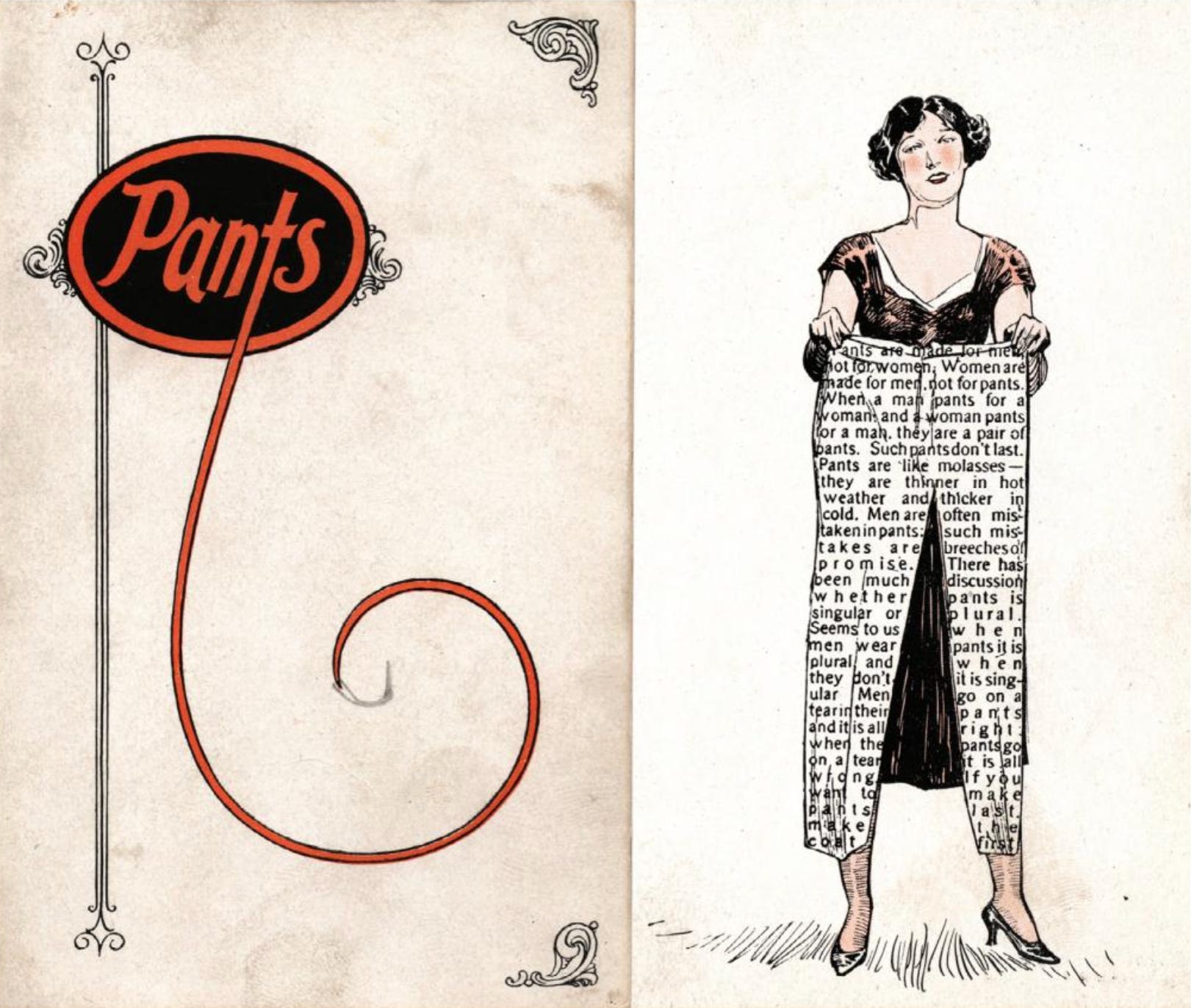
In contrast, there was something appealing about the plain men’s pyjama, with their boxy shape and striped patterns. In order to secure their right to partake in such charming garments, women had to use the means of thievery, trickery and gossip. The advertising of pyjamas for women was at first low, and women were far more likely to hear of this new form of nightwear through word of mouth than through magazines or movies.
Eventually, though, in the early 19th century, women began to wear pyjamas on stage and screen, which helped with their growing popularity. Upper class women began to throw pyjama parties, wearing dresses to the assigned house, then changing into their nightsuits upon arrival. Because manufacturers were slow in making pyjama suits for women, women would simply buy them from the men’s section, claiming they were for their brothers or husbands. One woman, quoted anonymously in a New York paper, said that she had taken to wearing her husband’s pyjamas when they were on a trip and she forgot her nightgown: ‘My husband suggested in a joking way that I put on his pajamas and before he had time to draw a good breath I was in them and in bed…. After that I kept borrowing his pajamas until he had some made for me.’
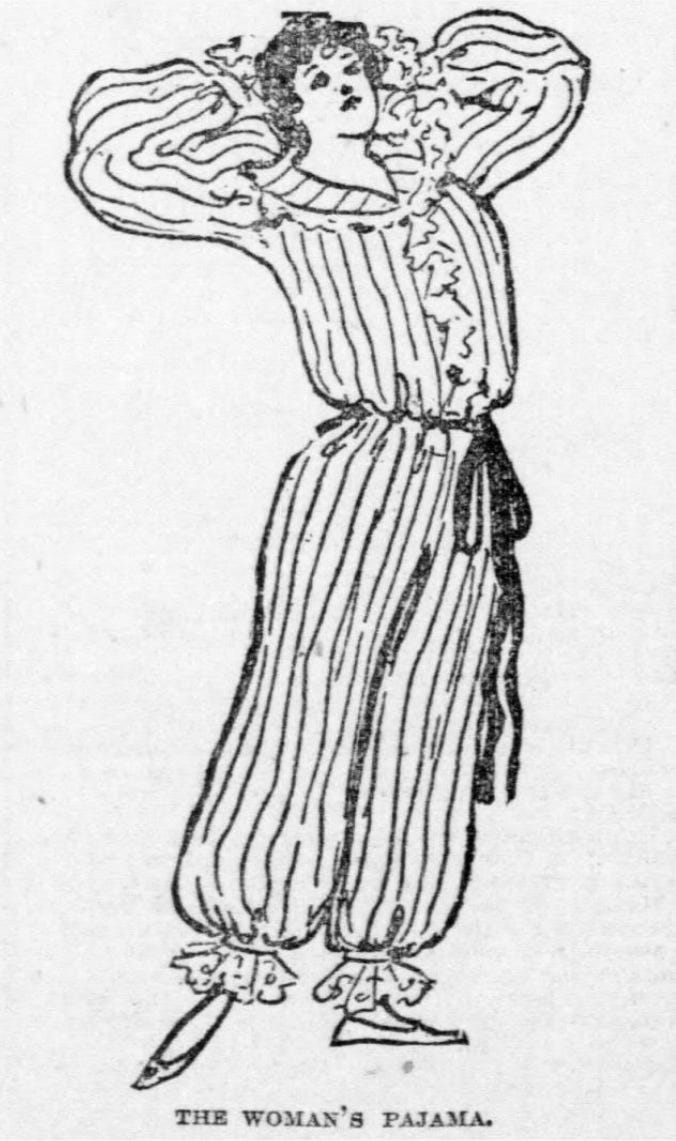
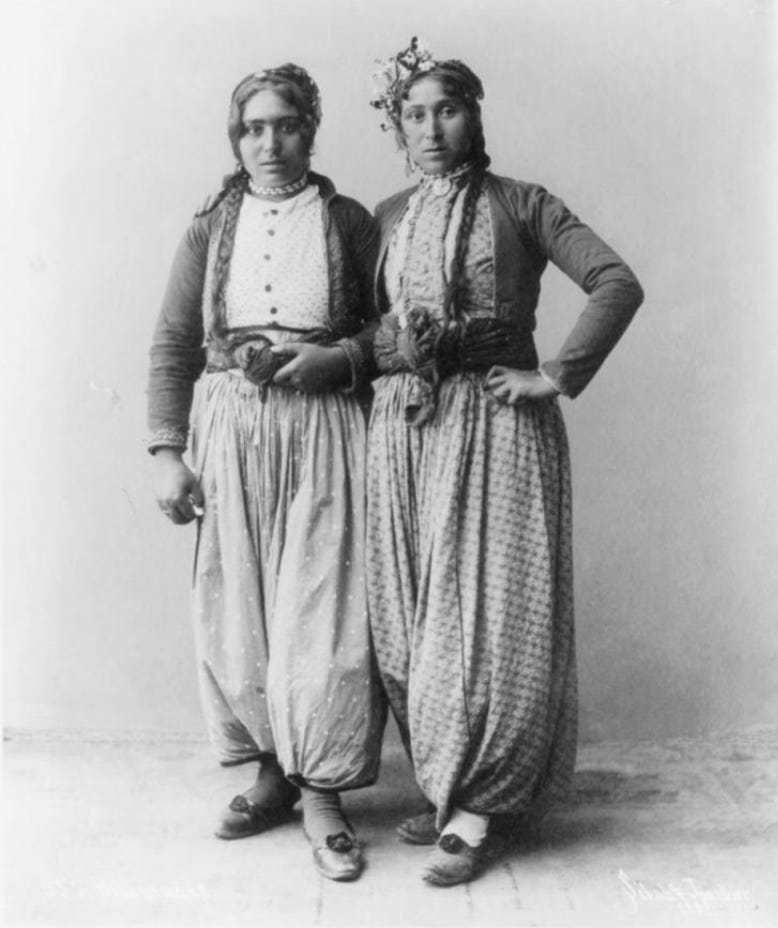
As the early decades of the 20th century passed, pyjamas became accepted womenswear, a form of nightwear that owed its origins to Asian and Middle Eastern countries, where men and women had been wearing the silhouette for centuries.
V
Pyjamas, say D’Agati and Schiff, were ‘well-suited to a society already accustomed to having specific garments for every occasion and time of day’. The reverse seems true now; pyjamas are ill-suited to a society whose occasions and times of day have melted into one another. Since the pandemic, working from home has confused our dressing sensibilities. Over the last few decades, another category has emerged between daytime clothing and nightwear: loungewear. It is this latter category that is most suitable for a society who may be working or exercising in their homes more than they are actually sleeping in them.
There are other sartorial boundaries that are now blurred — athleisure wear, for example, need not be worn exclusively in the gym. The pyjama, in the modern clothing landscape, has thus become curiously rigid, whose primary, if not sole, purpose is to be worn to bed. Even the lingerie of the ‘80s and ‘90s have been repurposed into dresses that can be appropriately worn in various public settings. Pyjamas, on the other hand, with their unmistakeable shirt-and-trouser silhouette, are one of the few garments we have left that would look truly odd if worn in public.
Economic pressure must also be factored in; in times of financial difficulty, buying an extra outfit (which, moreover, is relegated to nightwear and will hardly be seen by anyone but the wearer themselves — something that makes especially little sense in a performative age in which very few spaces survive that are truly intimate and cannot be commodified for social media) seems ridiculous. Sleepwear thus begins to consist of the ratty old t-shirts, shorts and joggers that are no longer suitable for outdoor use.
There is nothing exactly wrong with this. But we risk forgetting the perks of pyjamas: their effortless sweet style, combined with undeniable comfort. This is something that only occurred to me fairly recently. The pyjamas that got me into pyjamas weren’t even my own, they were my sister’s. One night last year I was home alone, my laundry bag filled to the brim with the ratty old tshirts and lumpen trousers I used for nightwear. Nothing was clean, everything was ugly. So I took some pyjamas from a freshly laundered pile of clothes on my sister’s bed. They were a classic set, a buttoned shirt and trousers, vertically striped in black and white. After I had put them on, I brushed my teeth and, looking distractedly at my reflection in the bathroom, thought: I have got to get me some of these bad boys.
VI
Jose Collins, star of the film A Woman’s Honor, and an early adopter of pyjamas, told the Courier-Journal in 1916:
I have pyjamas — or garments fashioned on pyjama lines, for every hour of the day. For sleeping, I use shell pink crepe de chine ones. For the morning lounge, ciel blue Italian silk. For luncheon, at home, Nile green taffeta ones trimmed with mose rosebuds. For afternoon when I am expecting only intimate friends, my pyjamas are made of soft satins in dull Oriental colourings, such as lapis lazuli blue or jade green. And for dinner at night I have several sets of white brocade, trimmed either in old laces or silver. I am not radical enough to inflict my friends with what they consider my idiosyncrasies. So when I visit them I dress conventionally. But maybe someday women will awake to the fact that they can be comfortable and in fashion at the same time.
VII
For the record, I still have old, worn-out pyjamas, too. Like my red nightshirt that has the Welsh flag printed in a large, faded love heart on the chest. Or my leopard print pyjama set from Tesco that my mam got me, to replace the last set of leopard print pyjamas she got me from Asda.
VIII
In a recent interview, Celine Dion encountered a journalist who told her he ‘live[s] for’ her couture wardrobe. Quick as a flash, before the interviewer could move on, Dion said, ‘you should have seen me this morning!’ ‘What were you wearing?’ asks the interviewer. Dion smirks, scoffs slightly, then says: ‘Agent Provocateur […] Agent Provocateur, just waking up. With a lace slip. Shocking pink. With a lavender little lace. And a robe. And what else? Bare feet?’ (Here, she turns to the camera to pronounce: ‘uh-uh!’) ‘Heels. Shocking pink heels.’ The interviewer asks, ‘for who?’ ‘For me, myself and I,’ says Dion, with relish. A true journalist, the interviewer presses her, ‘no, no, there’s gotta be a boo somewhere in there, because I don’t wear Agent unless there’s a man who’s gonna be looking at me in it.’ Suddenly, Dion’s demeanour transforms from diva into ex-mafioso as she says, ‘Listen. I got no man. I got no lady. I got nobody. I do it for myself.’
Céline Dion my goodness 💞 This made me want to upgrade my pjs