
drown'd, drown'd
some thoughts on Ophelia

In 1623, in his medical treatise Erotomania, Jacques Ferrand considered the possibility that women could die from love. A couple of centuries earlier, the medical condition of lovesickness was thought of as a kind of occupational hazard for male nobility, whose joblessness generated excessive libido. By the 17th century, however, it had become an ailment that women could suffer from: ‘perhaps Men appeare outwardly to be the more to Lust of the two,’ wrote Ferrand, but ‘if you… could but as easily see into the hearts of these Women; you shall there discover an equall Heat in both.’ Women suffering from lovesickness were bad news, though — far more dangerous than posh boys dying for a shag: ‘Women are Naturally of meaner Spirits and lesse courage, then Men; neither is their reason so strong as theirs: and therefore are they lesse able to make resistance against so strong a Passion.’
Women’s bodies, and their bodily desires, were not within their control and so, for them, lovesickness could be fatal. In contemporary medical thought, all bodies were made up of the four humours: blood, phlegm, yellow bile and black bile. Physical and mental ailments were thought to be caused by an imbalance of these liquids — melancholy, for example, was caused by an excess of black bile. Women’s bodies had the further complication of their menstrual cycle; menses were yet another liquid, making their bodies’ internal balances far more susceptible to going off kilter. Not only that but, according to academic Megan Snell, ‘women’s bodies were thought not only to contain more liquid but also to fail more frequently to control their liquids’. (I know, I know: ew!)
Lovesickness was not the only humoural disease that women were said to suffer from: there were a whole host of uterine disorders, caused or exacerbated by lust, that they could be diagnosed with. There was greensickness, an ailment similar to anemia and thought to be suffered by young, unmarried women. Then there was hysteria and also uterine fury — the symptoms of which resemble our modern day understanding of nymphomania.
Ophelia remains one of the most famous representations of female lovesickness. She originates in the Shakespeare play Hamlet, and while the titular prince feigns placidity, then madness, then sanity as he grapples with the fact his uncle killed his father then married his mother, Ophelia suffers her own pangs. She is passed around by the men in the play — Hamlet originally seems interested in her, an interest her father advises her to pursue, for the sake of power, but her brother advises her to avoid, for the sake of protecting her purity. Confused, she goes back to Hamlet, who rebuffs her harshly. She is deeply hurt; when Hamlet, in a fit of blind rage, kills her father, the grief sends her mad: powerless, betrayed, lovelorn, Ophelia goes to the nearest brook, where she drowns. Queen Gertrude (Hamlet’s mother) delivers the news to Ophelia’s brother, Laertes:
QUEEN GERTRUDE
When down her weedy trophies and herself
Fell in the weeping brook. Her clothes spread wide;
And, mermaid-like, awhile they bore her up:
Which time she chanted snatches of old tunes;
As one incapable of her own distress,
Or like a creature native and indued
Unto that element: but long it could not be
Till that her garments, heavy with their drink,
Pull’d the poor wretch from her melodious lay
To muddy death.
LAERTES
Alas, then, she is drown’d?
QUEEN GERTRUDE
Drown’d, drown’d.
LAERTES
Too much of water hast thou, poor Ophelia,
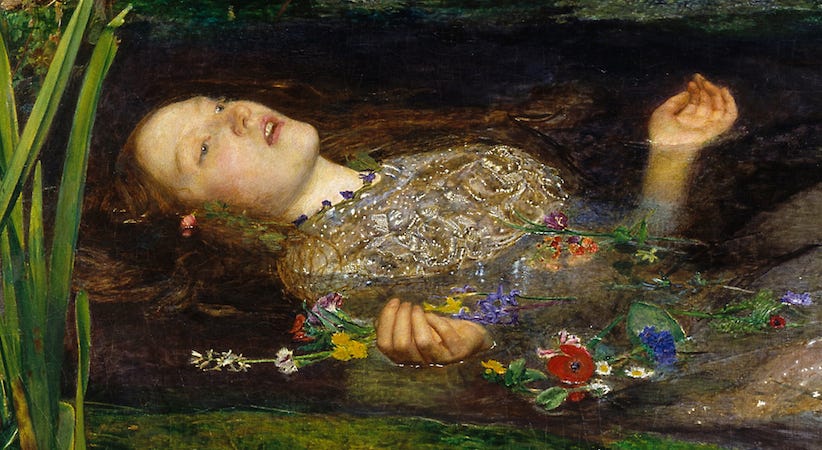
While contemporary audiences would have recognised Ophelia’s symptoms as lovesickness, and the woman herself as out of control, brimming with mad and bad desires, I think our present cultural understanding of Ophelia focuses mostly on her death, and the fate she seemed to accept with apathy. As in John Everett Milais’s infamous painting, Ophelia always comes to mind in a state of inertia and near-doom. The other versions of Ophelia — the one who flirts with Hamlet, or bickers with her brother, or grieves her father — have evaporated.
This much was made clear by ‘The Fate of Ophelia’, the lead single on Taylor Swift’s recently released album The Life of a Showgirl. Swift’s focus is not on Ophelia so much as it is on her fate, and her approach to Ophelia’s fate is to simply reverse it: although the narrator in the song almost ‘drowned in the melancholy’ of heartbreak, thankfully her dream man came along in the nick of time and saved her heart ‘from the fate of Ophelia’. In the second verse, Swift provides her own run-down of Ophelia’s story: ‘The eldest daughter of a nobleman / Ophelia lived in fantasy / But love was a cold bed full of scorpions / The venom stole her sanity’.
Swift has faced some backlash (by which I mean, some disgruntled TikToks, tweets etc) for the messaging of this song, which seems to be: Poor Ophelia! She should have just waited it out until a nicer man came along!
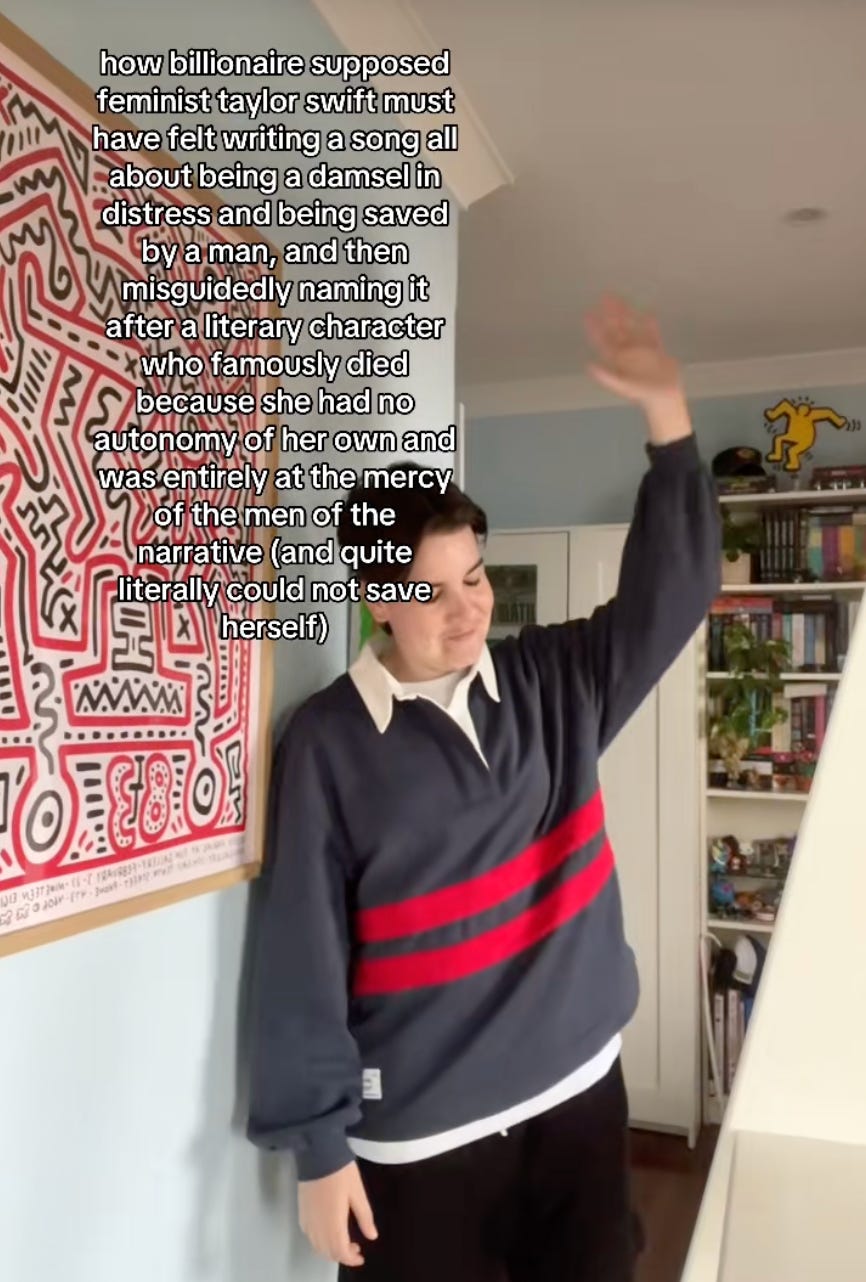
Obviously the song is pretty reductive, but I think getting too upset about vague literary allusions being used in a pop song about loving your boyfriend is a sign that you need real mental stimulation, and you should maybe read a novel or watch a very depressing documentary and snap out of it. Besides, Swift has always had a penchant for transforming morbid tales into happy endings. In ‘Love Story’, one of her earliest singles, she posed the question: what if Juliet’s father had relented and she and Romeo got married and lived happily ever after? Now she asks: what if Ophelia didn’t kill herself, but instead got engaged to a famous football player? Both good questions.
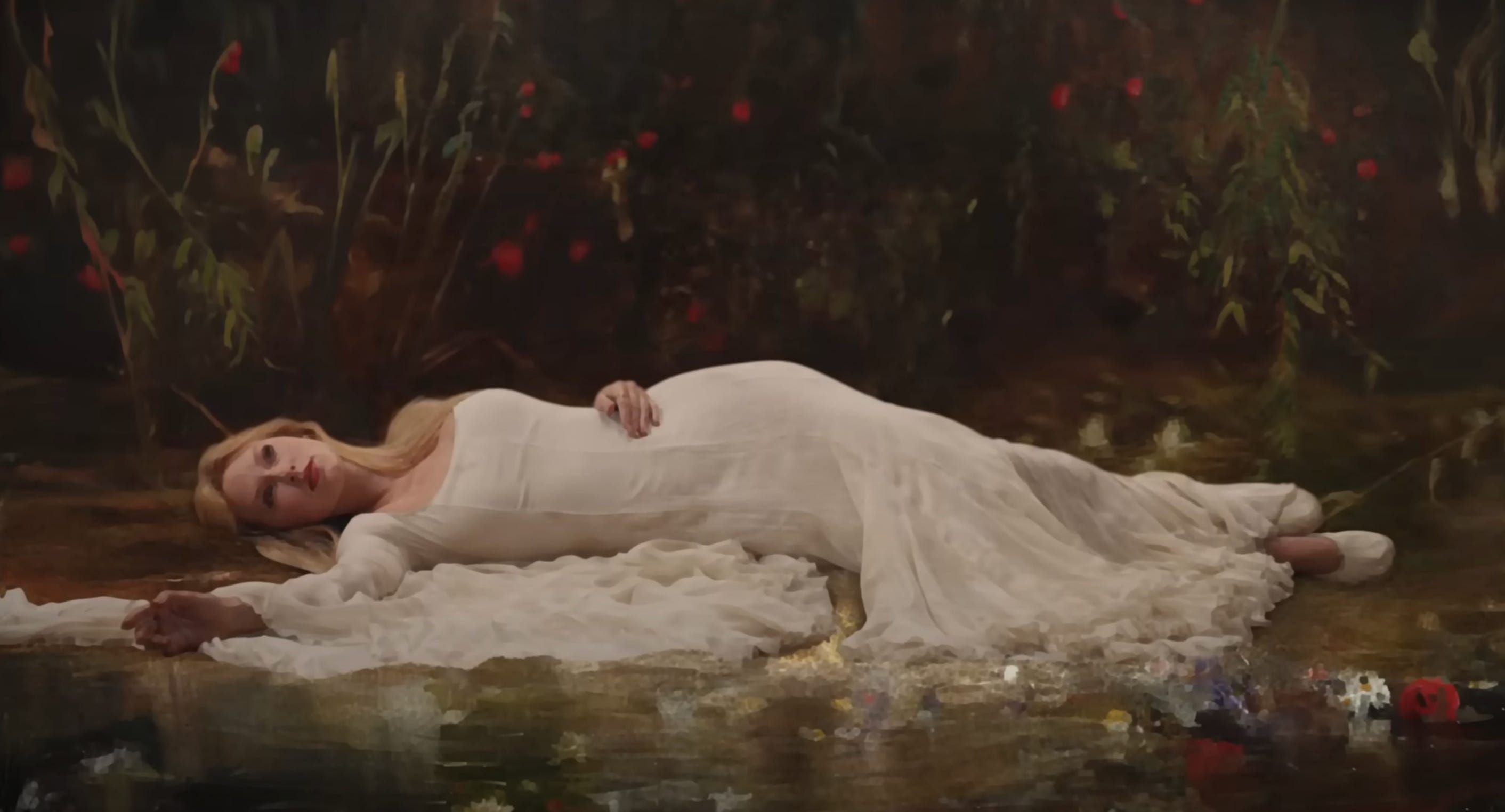
The music video is even more farcical. It follows Swift through a variety of scenes, beginning with her own version of the Milais painting, then moving to a ship on which she fights a group of pirates(?) — when she is thrown overboard, instead of drowning, she appears in a glittery swimming costume and cap, dancing in triumphant sync with a score of dancers bearing lifebuoys. I can’t help but interpret this, tonally, as: maybe she drowned — but I’m having the time of my life!!!

There are other pop songs which interpret Ophelia less jubilantly. My personal favourite is PinkPantheress’s ‘Ophelia’. It appears on her album Heaven knows (2023), which is full of various female characters experiencing messy, overwhelming desire. (In ‘True romance’, for example, a woman stalks a member of her favourite boyband, creating a parasocial relationship with him that culminates in the question: ‘I’m in the crowd, can you see my hands?’)
‘Ophelia’ is a haunting modern reinterpretation of Hamlet’s Ophelia. She is lured into her partner’s (or perhaps ex-partner’s) apartment; he texts her the invite, and she is surprised when she arrives that no one else is there. He proceeds to drown her in the bathtub, and we become privy to her final thoughts in the chorus: ‘my lungs aren’t workin’ / Liquid fills the inside of them, stops me talkin’ / You can see me underwater / As I descend, I see my life flash again’. Pink’s Ophelia is filled with regret (‘I wish I stayed at home in bed ‘cause then I might have survived’), powerless to the pure spite of her killer. When she briefly revives on the bathroom floor, she looks up and hopes someone has arrived to save her. Alas: ‘it’s you above me, ‘cause you wanna double check that I died.’
For those that wanted a pop interpretation of the story of Ophelia that is truer to its Shakespearean origins than Swift’s attempt, perhaps they would be satisfied with Pink’s attempt. Interestingly, she has made it clear in interviews that her own understandings of Ophelia’s origins are shaky, at best: ‘the song is called “Ophelia” because it’s about Ophelia from the book […] remind me, is it Macbeth or Hamlet? There’s one Shakespeare with a character Ophelia in it and she drowns herself because of something or whatever happened in the book, I can’t remember.’
Gonna go listen to Ophelia by pink now thanks for putting me on 🙏🏼